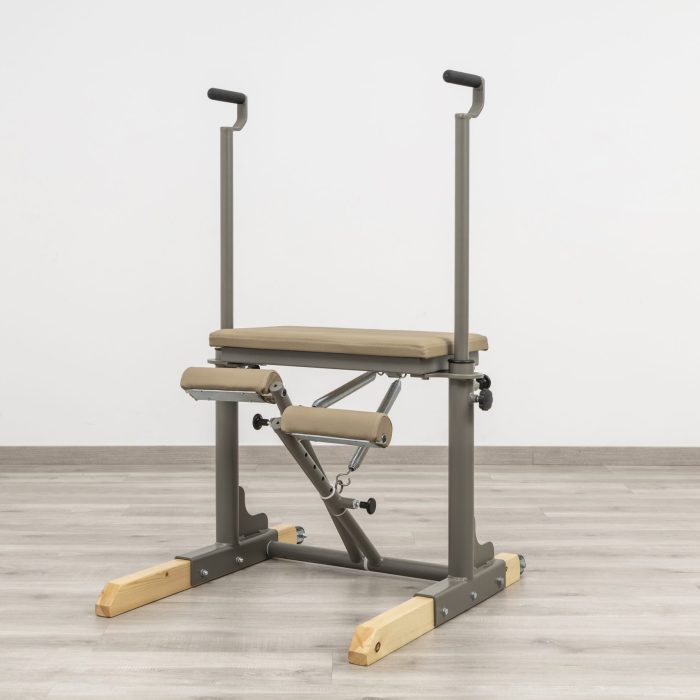


Pilates Chair
The Pilates Chair, also known as the Wunda Chair, is one of the lesser-known yet highly effective pieces of Pilates equipment. Originally created by Joseph Pilates, it was designed as a multifunctional apparatus that could be used even in small spaces. Despite its compact size, the Chair offers an impressive variety of exercises that build strength, stability, flexibility, coordination, and body awareness.
What Is the Pilates Chair?
The Pilates Chair is a piece of equipment designed for balance, strength, and spinal mobility exercises. Joseph Pilates created the Chair in the early 20th century to provide his clients — often dancers, athletes, and individuals in rehabilitation — with a way to continue their training even in limited spaces. Early versions of the Chair were so versatile that they could even function as furniture, doubling as a regular living room chair. Over time, the design evolved to include more ergonomic materials, springs with adjustable resistance, and removable handles, offering a wider variety of exercises and greater customization.
The Pilates Chair has a simple design yet remarkable functionality. It consists of a sturdy frame, usually wooden or metal, with a padded surface that serves as a seat or platform. Its most distinctive feature is the pedal, attached to springs, which moves downward when pressed with the feet or hands. Some models include a split pedal, allowing each side to move independently, thereby enhancing balance and strengthening the entire body. The springs provide adjustable resistance, tailored to the needs and abilities of each practitioner.
Using the Chair offers a wide range of benefits that align with the core principles of the Pilates method: strengthening the core, improving body alignment, and enhancing functional movement. One of its primary advantages is the activation and strengthening of the deep abdominal and spinal muscles, as nearly every exercise requires core engagement for balance and control.
In addition, the Chair develops both the upper and lower body, particularly targeting the legs, glutes, shoulders, and arms. Its use also greatly enhances balance and neuromuscular coordination. At the same time, the Pilates Chair promotes not only greater flexibility and joint mobility but also improvements in overall posture.
The Pilates Chair is suitable for a wide range of practitioners, regardless of age or fitness level. It is also extremely valuable in physiotherapy settings, particularly for individuals recovering from injuries or managing chronic musculoskeletal conditions.
Although the Chair is based on the same core principles as other Pilates apparatus, such as the Pilates Reformer or the Pilates Cadillac, its function differs. The Reformer relies on horizontal movement through a sliding carriage and long springs, making it ideal for fluid, full-body exercises. The Cadillac, on the other hand, is an elevated apparatus more suited to passive stretches and rehabilitation work.
Περρισότερα